 CAMPGROUNDER
Smoke over Superior.
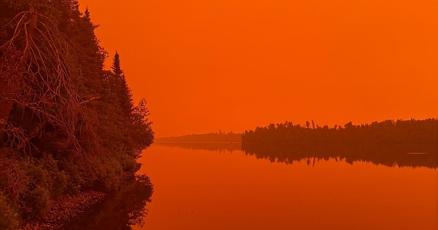
On Wednesday evening, an air quality monitor near Marquette, Michigan read over 1,000. The scale calls anything above 300 "hazardous." For a few hours this week, a lakeside town of 20,000 in the Upper Peninsula had some of the worst air on the planet, worse than any megacity, anywhere. We are writing this from inside it. The sun has been a dim orange coin for three days.
Where the smoke is coming from
Two fire stories are converging on Lake Superior, and it helps to keep them straight.
The first is Canadian. Northwestern Ontario is carrying roughly 148 active wildfires, 69 of them out of control, many burning in the boreal forest just north of Superior, far closer to the lake than in a typical smoke year. When the wind swings north, that smoke doesn't drift across three states to reach Michigan. It falls straight down onto the U.P., thick and low, which is why this week felt so different from the hazy summers of recent memory.
The second is ours. On July 7, a dry lightning storm walked across northern Minnesota and lit nineteen fires in the Superior National Forest in a matter of days. The largest, the Bear Trap fire, is now past 34,000 acres at zero percent containment. Combined, the Superior fires have burned roughly 77,000 acres, and fire managers are saying out loud that some of these may burn until snow falls.
The quietest million acres in America
On July 14, the Forest Service did something it almost never does: it closed the entire Boundary Waters Canoe Area Wilderness: all 1.1 million acres, every entry point, every lake, through October 1, or until the danger passes. Across the border, Quetico Provincial Park closed its backcountry too. Taken together, a paddling wilderness bigger than Delaware just went silent in the middle of its high season.
The ripple is bigger than the map. Ely and Grand Marais run on paddle season the way ski towns run on snow, and outfitters are watching their best weeks evaporate, with guides idle and canoes stacked on racks in July. And tens of thousands of displaced trips don't vanish; they land somewhere. If you're holding a reservation anywhere in the northwoods for August, hold it tight. If you're hunting for one, you now know why everything nearby is suddenly full.
It's worth saying plainly: the closure is the right call. Floatplanes scooping water, crews moving between lakes, and evacuation logistics don't mix with 150 canoe parties scattered across a roadless wilderness. Closing it is how the people fighting these fires keep the option of winning.
Camping around it
Smoke is weather. It moves, it thins, it clears, sometimes in hours. A cold front is forecast to scrub much of this weekend's air across the U.P. The skill is checking the right things in the right order:
Air first. Every Campgrounder listing shows a live Air Quality reading. Below about 100, camp. Above 150, rethink, especially with kids, older campers, or anyone with lungs that complain. Fire second. Our Wildfire Watch now pins official closures (the Boundary Waters and Quetico notices are up) alongside live fire proximity on every affected listing, with acreage, containment, and distance. Wind third. A north wind smokes the south shore of Superior; a south wind clears it. Thirty seconds with a forecast can trade a gray campsite for a blue one two hours west.
The longer view
The boreal forest is built to burn. Jack pine cones literally need fire's heat to open. Fire is how this country renews itself, and it has done so for ten thousand years. What's new is the tempo: hotter springs, drier duff, lightning that finds a readier fuel bed. This is not the last summer that will look like this one.
So here's the honest advice, camper to camper: don't stop going north. Just plan like a northerner: book the trip, and keep a Plan B a latitude away. The lake is still there behind the smoke. It'll be there when the wind changes.
Check conditions on Campgrounder →