Campgrounder

Find your
camp.

Press Kit September 2026 campgrounder.io hello@campgrounder.io
The paragraph you can paste 01 / 10

Campgrounder is a smart camping app for iOS and the web. It knows the place you're going, what conditions are like there right now, and how to get you in. Pick a camp and it reads the live public record for that exact spot: site availability from Recreation.gov, wildfire activity from NIFC and NASA, weather and air quality from Open-Meteo, bedrock from Macrostrat, species records from GBIF. Behind that sit 5,554 hand-checked campgrounds across all 50 US states and Canada, in seventeen categories, from national forests and Army Corps lakes to city parks and free dispersed land. It's free, requires no account, and takes no cut of any booking. It was designed and built by one person, Ben VanderVeen, and launched on the App Store on June 30, 2026.

5,554
Campgrounds
17
Categories
50
States, plus Canada
$0
To use, no account

Counts verified against the live catalogue on September 3, 2026. A build script rewrites every published number and fails the deploy if one has drifted, so the figures on this page and in the app cannot disagree.

At a glance 02 / 10
Product
Campgrounder, campground discovery for iOS and the web
Status
Live. iOS app launched June 30, 2026. Shipping continuously since.
Platform
Native iOS app on the App Store, plus an installable progressive web app. An Android build is complete and awaiting release.
Coverage
5,554 campgrounds across all 50 US states and Canada
Categories
Seventeen. Forest Service, State Park, Army Corps, National Park, BLM, Provincial Park, National Seashore, Glamping, Municipal, Dispersed, RV Park, Private, National Lakeshore, National Parkway, National Forest, County Park, Wilderness.
Live data
Recreation.gov site availability · NIFC and NASA EONET wildfire feeds · Open-Meteo weather and air quality · Macrostrat bedrock · GBIF species records
Price
Free. No account required. No booking fee, because Campgrounder does not take the booking.
Design
Bauhaus minimal, typography first. Deep forest green and campfire orange. The design system is called Cairn.
Origin
Born in Michigan, on the Great Lakes. Shaped by years in the Pacific Northwest.
Team
One. Ben VanderVeen, founder, designer and builder.
Ownership
Independently owned and operated.
The story 03 / 10

How a Michigan camper
built the camping app
nobody else would make.

There is a feeling that arrives in February, when the lake has frozen out to the horizon and every trailhead is under four feet of snow. You start scrolling. You type "best camping near me" and get back a twelve column grid of banner ads, sponsored listings, and a map that takes thirty seconds to load on a good connection.

For Ben VanderVeen, who grew up camping in Michigan and now works from Portland, that was the moment that started everything. Lake Superior, the backcountry around Northern Michigan University, cold water and a lot of pine. Finding somewhere new to sleep outside was getting harder, not easier, and every tool he found was built for clicks rather than for campers.

A camping app that is actually beautiful is more useful, because you want to use it.
Ben VanderVeen, Founder

The first thing anyone notices is the design. The screen is deep forest green, nearly black. The type is enormous and unapologetically heavy. The mark is a rounded orange triangle with a single pine tree cut out of the center, a tent and a tree in one shape. The orange took a while to land: it is the color of an ember at the exact right moment in a fire, not too yellow, not too red.

The second thing is what the app refuses to do. It does not sell placement, it does not take a cut of any booking, and it will not print a number it cannot verify. Where federal availability is live, it shows how many sites are genuinely open. Where it is not, it prints a dash.
The film 04 / 10

Campgrounder
in 57 seconds.

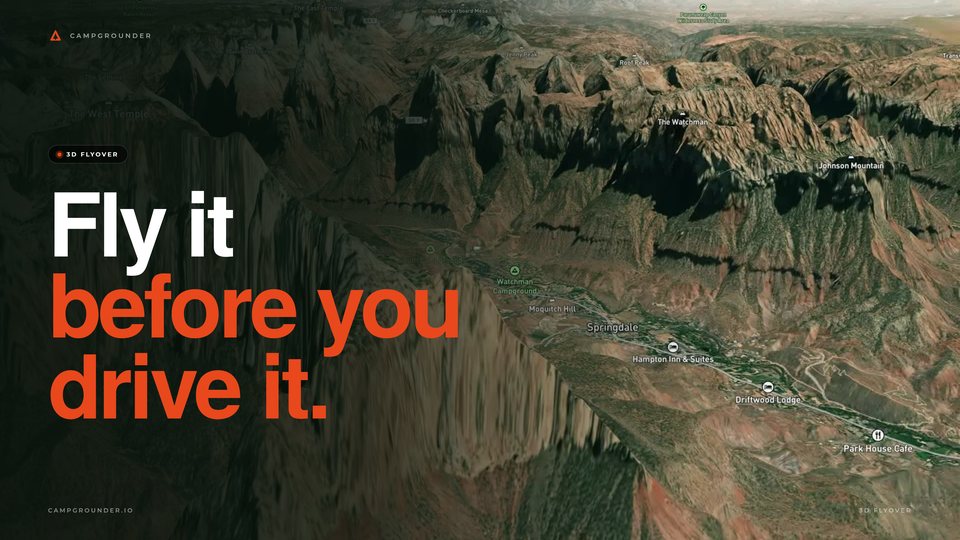
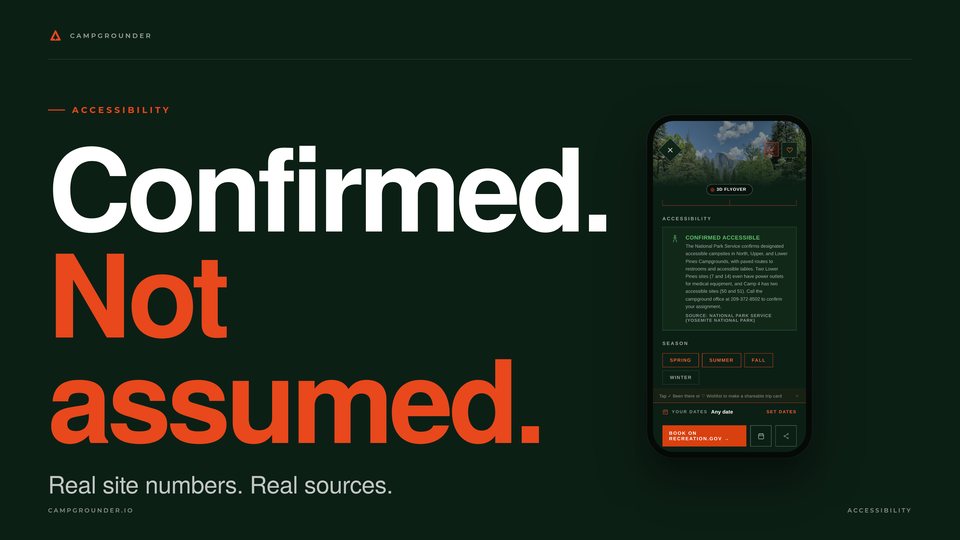
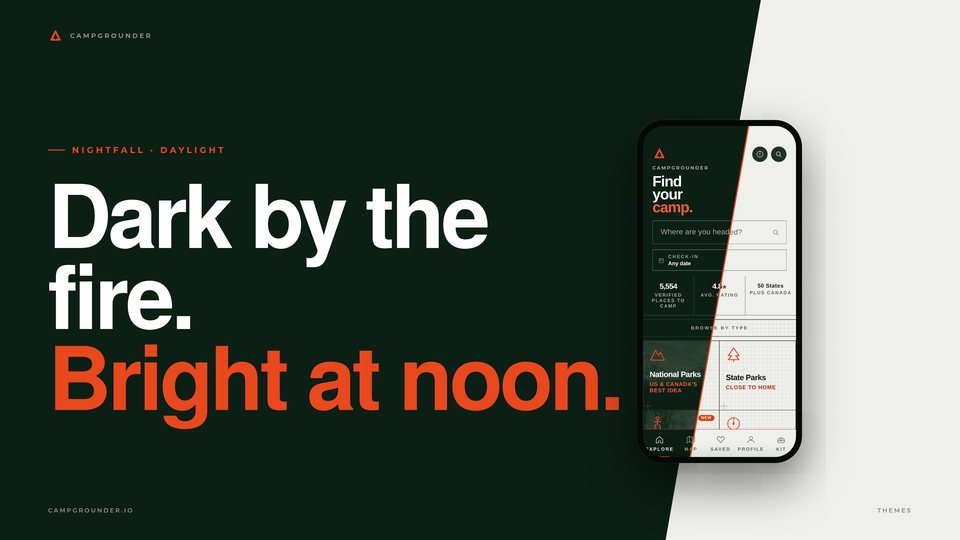
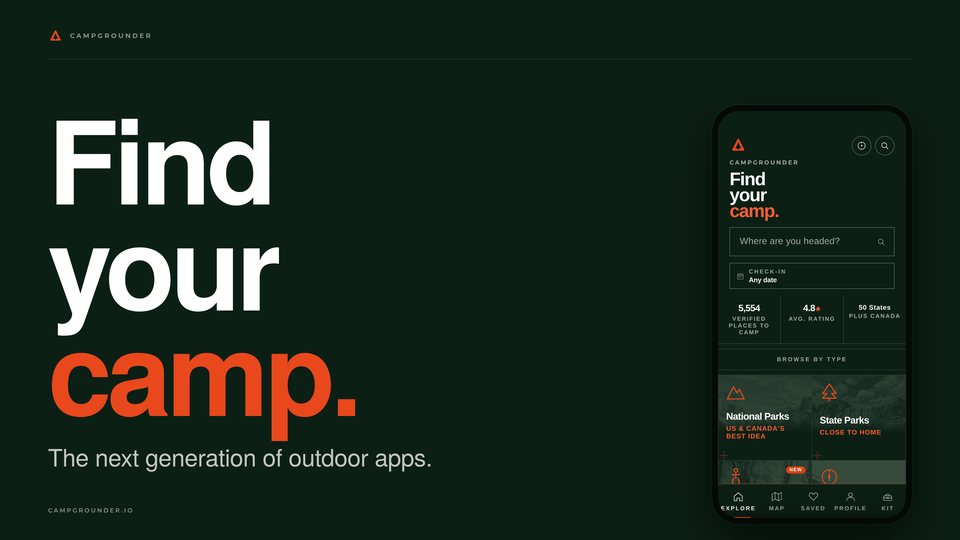
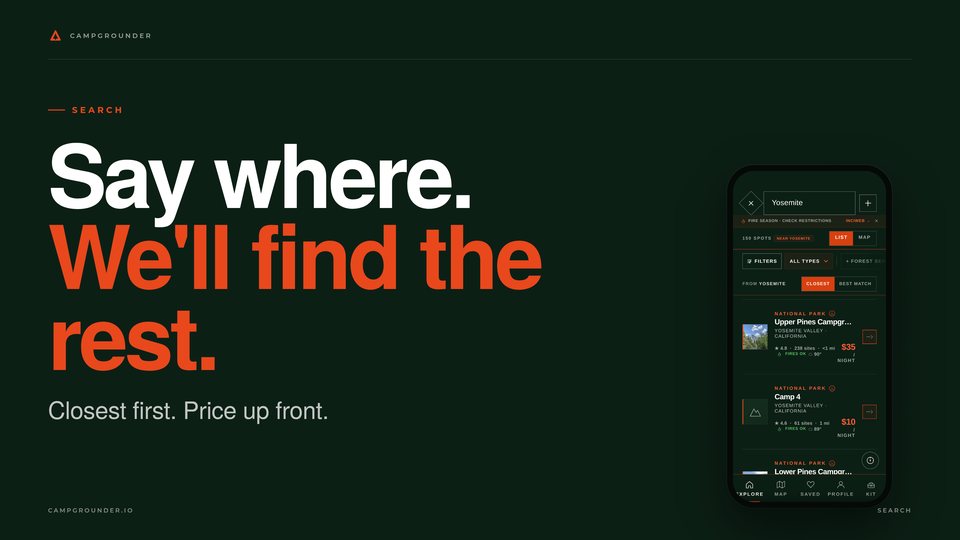
One idea per frame, in the app's own type. Search, live conditions, the 3D flyover, The Trail, Wildfire Watch, the rock under your tent, confirmed accessibility, and both themes. Cleared for broadcast, embedding and editorial use. The landscape cut plays from Vimeo with its score; the portrait cut and the downloads below are silent, so you can lay your own audio under them.

Landscape · 16:9 · With musicWatch on Vimeo
Portrait · 9:1657 s · No sound
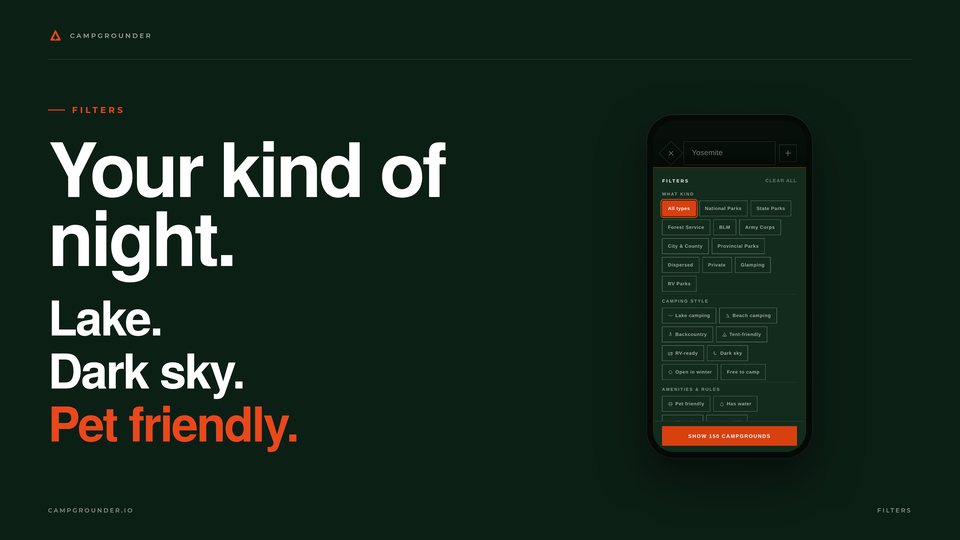
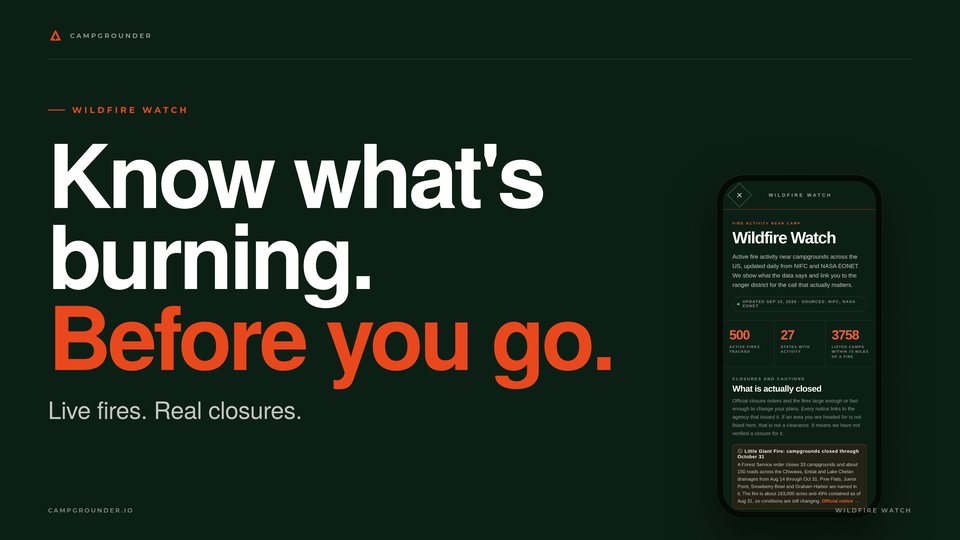
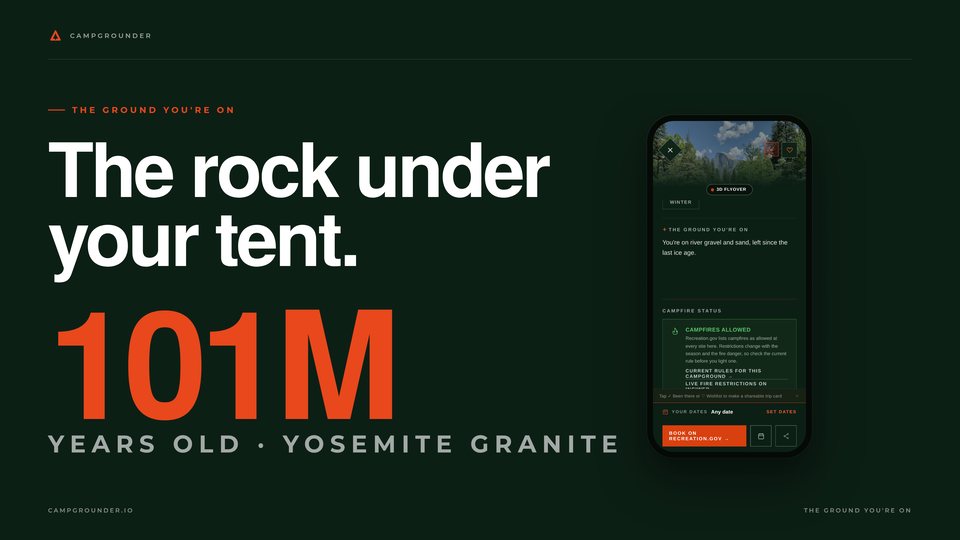
Find your camp. Say where. We'll find the rest. Your kind of night. Fly it before you drive it. Know what's burning. Before you go. The rock under your tent. Confirmed. Not assumed. Dark by the fire. Bright at noon.
What it does that the category does not 05 / 10
Booking

We don't take your reservation. We get you the site.

Nobody but Recreation.gov can book a federal campground. Every app that implies otherwise is quietly handing you off at the last second anyway, so Campgrounder says it on the button and hands you straight over. No cut, which means no reason to promote the campground that pays the most or round a price up.

The Ground You're On

The rock under your tent, and how old it is.

Every listing can tell you what its bedrock is and roughly when it formed, read from Macrostrat at the campground's own coordinates, alongside the animals, trees and wildflowers recorded nearby through GBIF. The label reads "recorded near here," never "you will see," because occurrence counts measure observer effort, not abundance.

Dispersed camping

Named corridors, never a pin on somebody's clearing.

Free camping on public land is a first-class category, listed as legal areas rather than GPS coordinates, because geotagging is how quiet places get loved to death. Each one carries the managing agency's current rules, quoted and dated, and no guessed campfire status at all.

Wildfire Watch

Fire activity, bound to the campgrounds it affects.

Live incident data from NIFC and satellite detections from NASA, with plain language warnings when a large or poorly contained fire sits near a bookable camp, and official closure orders attached to the specific campgrounds they name.

Privacy

There is no account, and there never was one.

Saved camps, trips and profile live on the device. Passwordless sync is available for people who want their list on two phones, and it is opt in. Profile photos are cropped and stored locally and are not uploaded anywhere.

Search

Type a place, or type a feeling.

A state, a city, a zip code, or a mood: dog friendly free camping, dark sky, waterfall hikes. Results are ordered on a continuous distance curve rather than in buckets, so the campground forty minutes away lands above the one two hours out instead of tying with it.

The catalogue 06 / 10

Where the 5,554 are.

Most camping directories are heaviest where the demand is. This one is heaviest where the campgrounds actually are, which is the national forest system. For every campground listed inside a national park there are close to six in a national forest, usually right next door and usually cheaper.

Forest Service
3,219
State Park
710
Army Corps
604
National Park
542
BLM
295
Provincial Park
43
National Seashore
27
Glamping
23
Municipal
19
Dispersed
17
Eight more categories
55
4,549
Carry a federal record ID
3,315
Link straight to the official booking page
2,685
Campfire status from a source, not a guess
70
Cost nothing for the night

Also: accessibility detail taken from an official record rather than inferred appears on 256 of them, and 64 open a satellite map of every individual campsite so you can pick the one nearest the water before you book. Michigan, where this started, has 168.

Cairn, the design system 07 / 10

Named for the stack of
stones one hiker leaves
so the next one can
find the route.

An audit of the app's stylesheet in September 2026 found 226 distinct colors, 53 font sizes and 47 letter-spacings. Forty-six different white transparencies were being used as text color alone, eleven of them doing the same job. It had never been a forty-six step system. It was a five step system with forty-one accidents in it.

Cairn is what replaced them: a layer of raw brand values, and above it a layer of tokens named for the job they do rather than the color they are. Components reference only the second layer, which is why a whole second theme costs thirty-six overrides instead of nine hundred edits. A check in the build pipeline counts what is left and refuses any change that raises the number.

The system gets a name. The variables do not. A token called text-3 tells you its job; a token called dusk tells you a mood and leaves you guessing.
On naming, from the Cairn documentation

The two themes are named for times of day at camp. Nightfall is the deep forest green the app has always used. Daylight is drawn from alpine hardware, Dyneema off-white with black webbing and orange accents, down to a ripstop weave rendered in pure CSS. This page is built from those same tokens, and the switch at the top is real.

Ember
#E8481C
The accent, the calls to action, and the mark itself
Forest
#0C1F15
Nightfall ground
Canopy
#132B1C
Nightfall panels
Dyneema
#EFEFEB
Daylight ground
Hardware
#171A15
Daylight edges, the black webbing that carries the page
Tile
#203429
App icon background

Type is Helvetica Neue for everything you read, with Montserrat reserved for the wordmark and tracked uppercase labels. On light grounds the accent shifts to a deeper orange, because brand orange measures only 3.4 to 1 against Dyneema and small text has to clear 4.5.

Milestones 08 / 10
Early 2026
Begins as a side project, a curated alternative to ad driven campground search.
Jun 30, 2026
Campgrounder for iOS launches on the App Store.
Jul 2026
Logbook trip cards, sunrise and sunset arcs, per campsite satellite maps, and coverage of all 63 US national parks.
Jul 2026
Live availability from Recreation.gov, with Cancellation Watch email alerts for sold out sites.
Jul 2026
Wildfire Watch and Camper's Caution, built on NIFC incident data and NASA satellite feeds.
Aug 2026
The Ground You're On: the rock under your tent and the species recorded nearby.
Aug 2026
Free dispersed camping becomes a first-class category, as named legal areas rather than pins.
Aug 2026
A dedicated wildfire hub goes live, with official closure orders bound to the campgrounds they name.
Sep 2026
Coverage passes 5,554 campgrounds after a full ingest of the federal recreation database.
Sep 2, 2026
Cairn ships: 169 design tokens, two themes, and a build check that will not let the system drift back.
Things we would rather you got right 09 / 10

The five things
coverage usually
gets wrong.

Most press kits only tell you what to say. This is the other half. If a fact check turns up something not on this list, write to us and we will correct it here.

Not this
"Book your campsite through Campgrounder."
Campgrounder is not a booking platform and does not process reservations. It hands you to whoever actually runs the campground, usually Recreation.gov or a state system, and takes no commission at any point.
Not this
"The largest campground database available."
We make no claim about being the biggest, and we would rather not be described that way. In a study of 3,816 App Store reviews across nine camping apps, database size appeared in 0.9% of positive reviews. What people actually complain about is price, search and accuracy.
Not this
"Rated 4.8 stars by campers."
Ratings in the app are estimates drawn from public sources, not aggregated first-party reviews, and the app labels them that way. Where a campground has no reviews behind it, the star is omitted rather than invented.
Not this
"Every campsite has verified accessibility information."
256 of 5,554 listings carry accessibility detail from an official record. The federal database publishes that text for roughly 1% of campgrounds, so the honest state is "not published," and that is what we are working toward showing.
Not this
"A team of outdoor enthusiasts built it."
One person built it, and he is not a developer by training. Ben VanderVeen is a designer who learned enough to ship an app, which is either the least interesting fact here or the most, depending on the story you are writing.
Ready to quote 10 / 10

Cleared for direct attribution to Ben VanderVeen, Founder, Campgrounder. Use as written, or write for a fresh one.

Every tool I found was built for clicks, not for campers.
On why it exists
I had zero interest in accounts or logins. Your camping profile is yours. It lives on your phone. I am not building a database of campers.
On privacy
The Great Lakes get written out of the camping conversation. People picture Utah, or the Sierra. Meanwhile there is freshwater coastline here you could spend a whole life on.
On Michigan
The best camping is the camping you almost did not book. The sites that turn up when you zoom into a national forest you have never heard of.
On discovery
Nobody but Recreation.gov can book a federal campground. Saying so on the button costs us the business model and buys us the trust.
On the booking handoff
Where a number cannot be verified, the app prints a dash. I would rather show a camper nothing than show them something I made up.
On the data
Assets Download
Press contact
Ben VanderVeen
Founder
Available for
Editorial coverage, tool round ups, outdoor technology features, and design interviews. Screenshots, founder availability and campground access provided on request.